ENEA Atlas for development cooperation
Italian National Agency for New Technologies, Energy and Sustainable Economic Development



ENEA makes use of a weather forecasting model that can be applied in different territorial contexts, e.g., to predict the amount of rain expected to fall on a given area and can be implemented to alert population in case of intense precipitations that is likely to put people, infrastructure, crops or the environment in jeopardy. The model can be integrated with other systems for monitoring and forecasting severe hydro-meteorological events such as, e.g., floods or landslides.
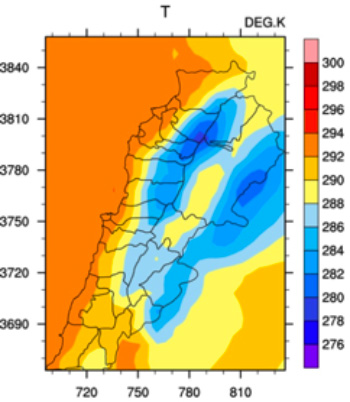
ENEA has a long consolidated experience on mesoscale meteorological modelling (with a spatial resolution from some tens to a few km), which has recently been applied to implement an atmospheric modelling system over Lebanon (see Figure 1). ENEA has also set up a forecasting system providing meteorological fields up to 3 days on Italy with a 4km resolution. Starting from such fields, forecasting on polluting concentrations is made by CTM (Chemical Transport Model) AMS-MINNI. The model can potentially reach spatial scales down to those of a nowcasting system (of the order of 1-2 km) on areas of some hundreds of kilometers.