ENEA Atlas for development cooperation
Italian National Agency for New Technologies, Energy and Sustainable Economic Development



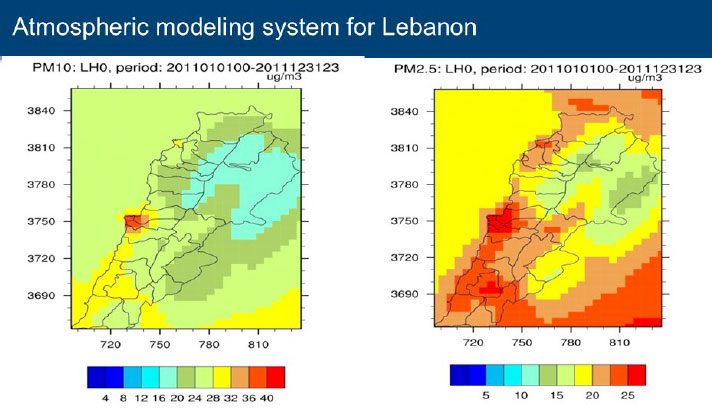
ENEA has developed a model for air pollution assessment using an Atmospheric Modelling System. Air pollution is a consequence of unsustainable economic growth and its impact on human health and vegetation. Starting from the knowledge of pollutant emission sources and atmospheric dynamics, the air pollution assessment model contributes to increasing knowledge of the impacts of different sources on airborne concentrations, identifying priorities for mitigation.
Research on atmospheric processes, applied meteorology, numerical modelling of atmospheric pollution for current and future scenarios analysis; both natural and anthropogenic emissions are considered. Identification and analysis of environmental risks from air pollution for the definition of mitigation strategies and specific policies for long-term environmental sustainability.
A Project on air quality was implemented in cooperation with the Lebanese Ministry of the Environment to investigate the effectiveness of abatement measures on large industrial facilities.